Showing posts with label Institute of Kidney Diseases and Research Centre. Show all posts

Wednesday, 14 October 2015

Eating sindoor puts man's life at risk


A 35-yr-old Mehsana resident wasdiagnosed with kidney failure after suffering from lead poisoning due toconsuming sindoor for 11 yrs
Sindoor is an integral part of the Hindu ritual used in mar riages and for religious pur poses. But did you ever hear of people eating sindoor? A 35year-old Mehsana resident visited Civil Kidney Hospital two months ago with complaints of acute abdominal ailments, vomiting and facial puffiness.

Brain dead woman's final act of kindness


School teacher Minakshi R Shete has given a new lease of life to five people. Respecting the last wish of the 63-yearold, who was brain dead, her family members donated her kidneys, eyes and liver.
“My mother taught at a municipal school. She was quite aware of the importance of organ donation.We are proud that she donated her body to help others lead a better life,“ said her son Ronak Shete, who works with a private farm.

Sunday, 13 September 2015

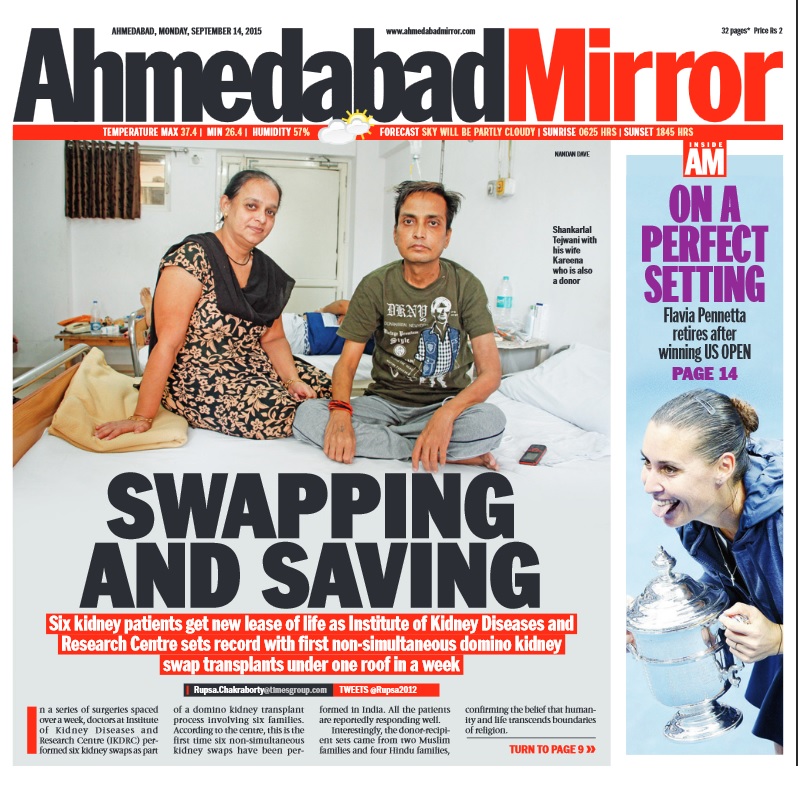
Swapping and saving


In a series of surgeries spaced over a week, doctors at Institute of Kidney Diseases and Research Centre (IKDRC) performed six kidney swaps as part of a domino kidney transplant process involving six families. According to the centre, this is the first time six non-simultaneous kidney swaps have been performed in the country. All the patients are reportedly responding well to the transplants.
Interestingly, the donor-recipient sets came from two Muslim families and four Hindu families, confirming the belief that humanity and life transcends boundaries of religion.

Saturday, 29 August 2015

When sisters gift love and life


Paresh Makwana, a 35-year-old daily wage labourer, suffered from kidney stones which ended up damaging both his kidneys. Newly married Makwana was fighting for his life when his 25-year-old sister, Varsha, gave him a new life by donating her kidney.
Makwana has two brothers and sisters, all of whom are married expect Varsha who readily agreed to donate her organ to save her brother's life.“When she saw me bed-ridden, she decided to sacrifice her dreams of getting married and donated her kidney to me.Very few sisters are like her,“ he said.
Makwana explained, “In our society, men do not generally marry a woman with one kidney as she is at risk of ailments in future. So, she decided against getting married. She will devote her life to god. Varsha took this decision only for me. She has gifted me a new life.“
Meenaben Marwari, the 40-yearold wife of a sarpanch from Vadodara district, donated her kidney to her 37year-old brother Mahesh Dagra. Talk ing to Mirror, her husband Mukesh Marwari said, “Mahesh was diagnosed with diabetes which affected both his kidneys. My wife was worried about his survival so she decided to donate her kidney to her brother.“
He added, “Though my wife is middle-aged, she didn't think twice before donating her kidney. Her love surprised all of us.“ On Rakshabandhan, a brother promises to protect his sister with his life when she ties the sacred thread of rakhi on his wrist. Yet, 11 sisters took on the role of protector in 2014 by donating their kidneys to their brothers.In comparison, only two brothers donated their kidneys to their sisters.
Similarly, out of the total 21 sibling kidney donations in 2013, 19 were made by sisters for their brothers whereas only two brothers donated their kidneys to their sisters. In 2014, no liver donation has been recorded among siblings. Regarding gender disparity in organ donation, Dr Priya from Institute of Kidney Diseases and Research Centre (IKDRC) said, “Out of the total 348 kidney donations made in 2014, only 3.7 per cent are provided by siblings. Of this, only 15 per cent of them are provided by brothers which is saddening.Why should sisters always donate their organs? Sibling love should be both ways. Brothers should also donate to save the lives of their sisters.“
Dr Vivek Kute, nephrologist at IKDRC said, “In most families, males are the main bread-earners. They generally avoid donating organs as they do not want to risk their lives and the survival of their families.“

Friday, 17 July 2015

IN DEEP WATER


Thousands of people across the state have been condemned to drink groundwater with naturally high quantities of arsenic and fluoride that can have serious repercussions on their health, according to the central government. However, the Gujarat government has turned a blind eye to the concerns raised by the Centre asserting that not a single case of fluorosis and arsenicosis has been reported from the state. To top it all, a sanctioned sum of over Rs 150 crore by the Union government meant for ‘arsenic and fluoride-affected habitations’ remains unused.
Government and private hospitals have maintained that they have been steadily receiving patients with ailments caused by arsenic and fluoride, but the state continues to maintain an ostrich-like approach to the grave situation.

Monday, 2 February 2015

Microbes, heavy metals slip past AMC water labs

# 8,000 Amdavadis were diagnosed with diarrhoea in 2014, up by about 25 per cent over the 2013 figure.
# Jaundice and typhoid have also raised their heads as their cases soared by 26 per cent and 44 per cent respectively.
 Despite the shocking surge in the water-borne diseases in the city, Ahmedabad Municipal Corporation’s water testing laboratories are not equipped to test advanced microbes and heavy metals and in drinking water as prescribed by World Health Organisation (WHO). This is not only contributing to rise in water-borne diseases but also damaging vital body organs like kidney, liver, bone and blood.